Get in touch for product inquiries, technical support, or business partnerships regarding polymer additives and specialty chemicals.
Siya Polymer & Speciality Chemicals
Flat No 306 Crown C1 Stella Apartment, Moshi, Pune
Pune, Maharashtra, India – 412105
Siya Polymer & Speciality Chemicals
Rajiv Gandhi Nagar, N2 Cidco
Chh. Sambhajinagar (Aurangabad), Maharashtra, India – 431001
Monday – Sunday: 9:00 AM – 6:00 PM
Polypropylene Compounds are advanced engineering thermoplastic materials produced by blending polypropylene resin with additives, fillers, reinforcements, minerals, impact modifiers, UV stabilizers, flame retardants, and color masterbatches. These customized PP compounds provide enhanced strength, stiffness, heat resistance, chemical resistance, durability, and dimensional stability for industrial applications.
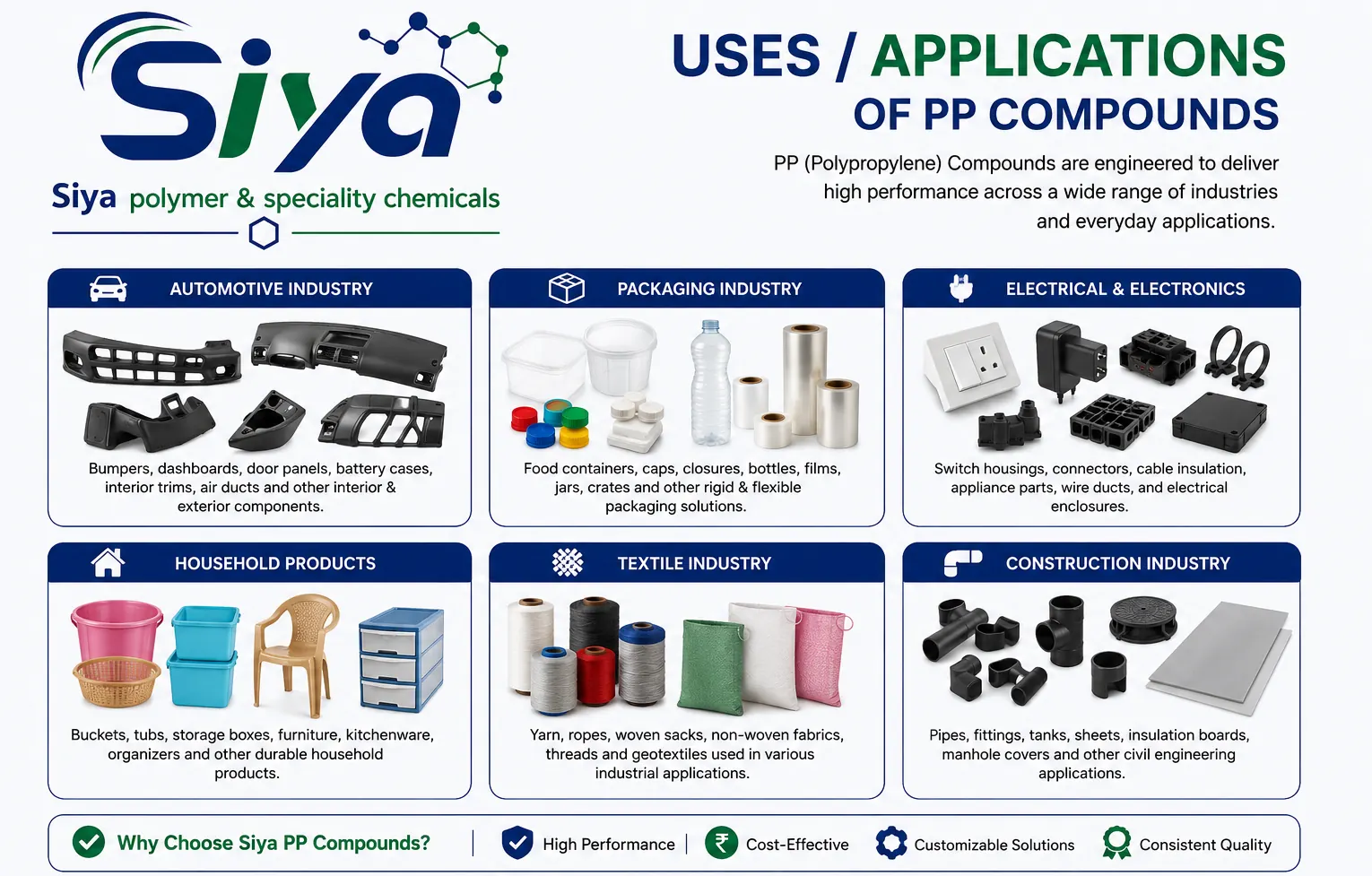
Polypropylene compounds are widely used in automotive parts, electrical components, household appliances, furniture, battery cases, packaging solutions, industrial products, medical devices, and consumer goods. Their lightweight properties, cost-effectiveness, and excellent mechanical performance make them suitable for demanding engineering applications.
Virgin Polypropylene is the base polymer resin without modifications, while PP compounds are specially engineered by adding fillers, glass fibers, minerals, talc, impact modifiers, and performance-enhancing additives. Polypropylene compounds offer superior mechanical strength, heat resistance, dimensional stability, and application-specific performance compared to standard virgin polypropylene.
Polypropylene compounds are extensively used in automotive, electrical and electronics, packaging, healthcare, furniture, construction, consumer products, agriculture, industrial manufacturing, and appliance industries. Their versatility and engineering properties make them one of the most widely used thermoplastic compound materials worldwide.
Polypropylene compounds are manufactured through a compounding process where polypropylene resin is mixed with fillers, glass fibers, talc, minerals, stabilizers, pigments, and functional additives using twin-screw extruders. The molten blend is then cooled, pelletized, quality-tested, and supplied as ready-to-process engineering plastic compounds.
Glass-filled polypropylene compounds provide higher tensile strength, improved rigidity, better dimensional stability, enhanced heat resistance, lower shrinkage, and excellent impact performance. These benefits make glass fiber reinforced PP compounds ideal for automotive components, electrical housings, appliance parts, and structural applications.
Yes, most polypropylene compounds are recyclable and can be reprocessed into new products depending on the formulation and application requirements. Recyclable PP compounds help reduce environmental impact, support sustainability initiatives, and contribute to circular economy practices in the plastics industry.
Glass-filled polypropylene compounds, talc-filled PP compounds, mineral-filled PP compounds, and impact-modified polypropylene compounds are among the best choices for automotive applications. These engineering PP compounds offer lightweight performance, high strength, excellent dimensional stability, heat resistance, and cost efficiency for automotive interior, exterior, and under-the-hood components.