Impact Modifier for Nylon Compounds: How to Toughen PA6 & PA66 Without Losing Strength
Nylon is strong, but straight out of the resin it can be notch-sensitive and brittle in the cold - here's how the right impact modifier fixes that.
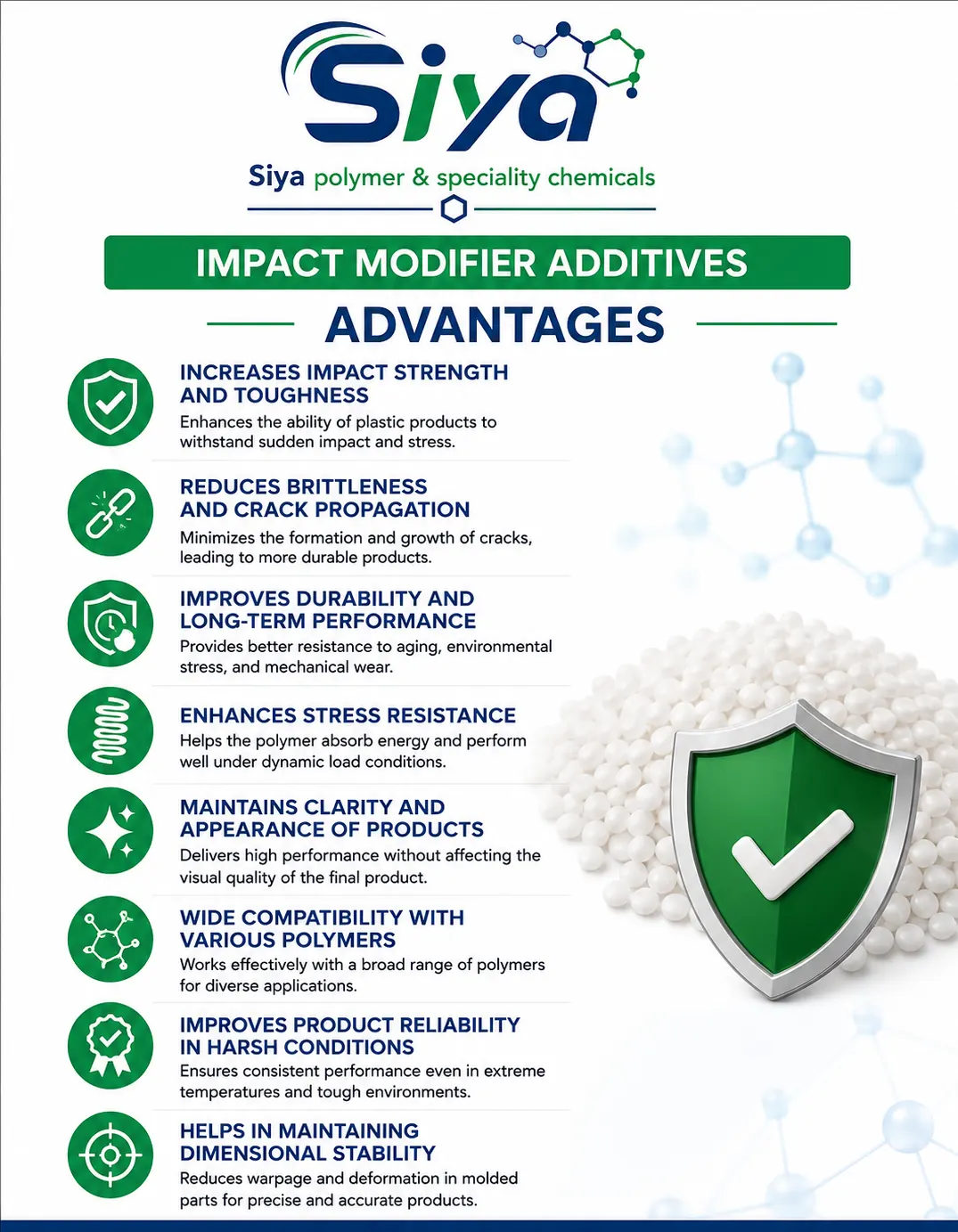
What Is an Impact Modifier for Nylon Compounds?
Quick answer: An impact modifier for nylon is a maleic-anhydride-grafted elastomer - typically EPDM-g-MA or POE-g-MA - melt-blended into Nylon 6 (PA6) or Nylon 66 (PA66) to create a fine, well-dispersed rubber phase that absorbs impact energy and stops cracks from propagating through the rigid nylon matrix.
Unmodified nylon has good tensile strength and heat resistance, but it is notch-sensitive and can fail suddenly under sharp or low-temperature impact - especially in the dry-as-molded state before it has absorbed ambient moisture. Toughening the compound with the right elastomer package solves this without giving up nylon's core mechanical and thermal advantages.
Why Nylon Compounds Need Impact Modification
- Prevents brittle, shattering-type failure under sudden or notched impact
- Protects parts from cracking in cold-start and sub-zero conditions
- Reduces sensitivity to the dry-as-molded vs. moisture-conditioned property swing
- Improves long-term durability of load-bearing and snap-fit components
- Enables thinner, lighter part designs by removing the risk of impact failure
Common Impact Modifiers Used in Nylon
EPDM-g-MA (maleated EPDM): the most widely used toughener for PA6 and PA66 - the grafted maleic anhydride reacts in-situ with nylon's amine end groups during compounding, giving strong interfacial adhesion and a stable core-shell rubber morphology.
POE-g-MA (maleated polyolefin elastomer): offers a similar reactive-compatibilization route with better low-temperature flexibility, often used where sub-zero impact performance is the priority.
Core-shell impact modifiers: used in specialty and glass-filled nylon compounds where a very controlled, uniform particle size is needed for consistent toughening across batches.
How Nylon Impact Modification Works
During melt compounding, the maleic anhydride groups on the elastomer react with the terminal amine groups of the nylon chain, chemically bonding the rubber phase to the nylon matrix instead of just physically mixing with it. This reactive compatibilization keeps the rubber particles small (typically sub-micron) and evenly dispersed, which is what actually delivers the toughening effect - poorly compatibilized blends give large, uneven rubber domains and inconsistent impact results.
Standard vs. Super-Tough Nylon: What's the Difference?
Standard impact-modified nylon uses roughly 5-10% elastomer to lift notched Izod impact strength for general-purpose parts. Super-tough nylon pushes elastomer loading to around 15-25%, sacrificing some tensile strength and stiffness in exchange for near-unbreakable impact performance - the compound of choice for parts that simply cannot fail under shock loading, such as automotive under-hood clips and power tool housings.
Applications of Impact-Modified Nylon Compounds
Impact-modified PA6 and PA66 compounds are used in automotive under-hood and structural components, gears and bushings, power tool housings, cable ties, sporting goods, industrial fasteners and glass-filled nylon parts that need both stiffness and toughness in the same design.
Get technical grade recommendations, dosage guidance, pricing and samples from Siya Polymer & Speciality Chemicals.
View Nylon & Engineering Plastic Compounds & Enquire →